




Table of Contents
You cannot cancel road tax simply because you no longer want to pay it. You must tell DVLA when there has been a qualifying change involving your vehicle.
- Sold Your Vehicle – Tell DVLA that you have sold or transferred it
- Taking It Off the Road – Make a Statutory Off Road Notification, known as a SORN
- Vehicle Was Written Off – Tell DVLA about the write-off
- Vehicle Was Scrapped – Notify DVLA that it has been scrapped
- Vehicle Was Stolen – Report the theft and follow the separate refund process where required
- Vehicle Was Exported – Tell DVLA it has permanently left the UK
- Vehicle Is Exempt – Update the vehicle to the correct tax class where applicable
Once DVLA receives the correct information, vehicle tax is normally cancelled. Any Direct Debit is also cancelled automatically, and you can usually receive a refund for any full unused months of vehicle tax.
The official DVLA vehicle tax cancellation and refund guidance confirms that there is no other way to cancel vehicle tax outside the qualifying circumstances above.
Last Updated: 01.09.2026
What Is Road Tax?
Road tax is the common name for Vehicle Excise Duty (VED). It is also commonly called vehicle tax, car tax or DVLA tax.
Most vehicles that are used or kept on public roads in the UK need to be taxed. The amount payable can depend on factors such as when the vehicle was first registered, its emissions, fuel type and tax class.
Vehicle tax should not be confused with car insurance or MOT requirements. These are separate legal responsibilities, although they can become relevant when taking a vehicle off the road.
When Can You Cancel Road Tax?
DVLA allows vehicle tax to be cancelled when a specific change has happened to the vehicle.
| Reason | What You Need to Do |
| Vehicle Sold or Transferred | Tell DVLA that you have sold or transferred the vehicle |
| Vehicle Kept Off the Road | Make a SORN |
| Vehicle Written Off | Notify DVLA following the appropriate write-off process |
| Vehicle Scrapped | Tell DVLA the vehicle has been scrapped |
| Vehicle Stolen | Report the theft and follow the vehicle tax refund process |
| Vehicle Permanently Exported | Tell DVLA that the vehicle has left the UK |
| Vehicle Becomes Exempt | Change the vehicle to the appropriate tax class |
You cannot normally cancel vehicle tax simply because you have temporarily stopped driving the car while it remains on a public road.
If the vehicle is not going to be used and will be stored on private land, making a SORN is normally the appropriate option.
What Do You Need to Cancel Road Tax?
The information you need depends on why the road tax is being cancelled, but it is useful to have the following ready:
- Vehicle Registration Number
- V5C Log Book
- V5C Document Reference Number
- Date the Vehicle Was Sold, Transferred or Changed
- New Keeper Details Where Applicable
- Insurance or Scrapyard Information Where Relevant
- Police Crime Reference Details for a Stolen Vehicle Where Required
Your V5C is particularly important because DVLA uses the registered keeper information when processing changes and issuing correspondence.
If your V5C is missing, you may need to obtain a replacement or follow a different DVLA process.
How to Cancel Road Tax Online?
The exact process depends on why you are cancelling the tax. There is not one universal cancellation button that allows motorists to stop road tax for any reason.
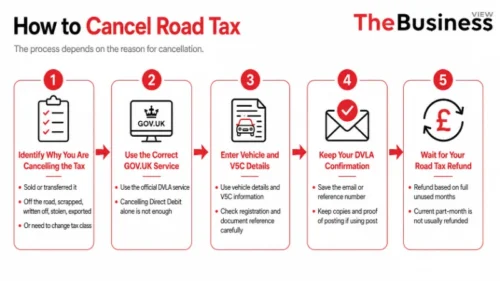
Step 1: Identify Why You Are Cancelling the Tax
Start by establishing which DVLA category applies to your vehicle.
This could be because you:
- Sold or Transferred It
- Are Taking It Off the Road
- Scrapped It
- Had It Written Off
- Had It Stolen
- Exported It
- Need to Change Its Tax Class
Choosing the correct process is important because your refund is generally calculated from when DVLA receives the relevant information.
Step 2: Use the Correct GOV.UK Service
Use the official DVLA service that applies to your circumstances.
Avoid assuming that cancelling a bank payment is enough. Cancelling your Direct Debit by itself does not tell DVLA that you have sold the vehicle or taken it off the road.
Step 3: Enter Your Vehicle and V5C Details
Where the process can be completed online, you will usually need vehicle details and information from your V5C.
Check the details carefully before submitting them, particularly the registration number and document reference.
Step 4: Keep Your DVLA Confirmation
Save any confirmation email or reference number you receive.
If you send documents by post, consider keeping copies and proof of posting in case you need to follow up with DVLA.
Step 5: Wait for Your Road Tax Refund
If you qualify for a refund, DVLA normally calculates it using the number of full unused months remaining on the vehicle tax.
Your current part-month is not normally refunded.
How to Cancel Road Tax After Selling a Car?
When you sell or transfer a car, the road tax does not transfer to its new keeper.
You should tell DVLA as soon as the vehicle changes hands. Once the change has been processed:
- Your Vehicle Tax Is Cancelled
- Your Direct Debit Is Normally Cancelled Automatically
- A Refund Is Calculated for Full Remaining Months
- The New Keeper Must Tax the Vehicle Before Using It
This is why the buyer cannot simply continue using the road tax that the previous keeper paid for.
The V5C is normally used to complete the keeper-change process. If the relevant document is unavailable, the procedure can be different, so it may also be useful to understand how to tax a car without a V5.
How to Cancel Road Tax With a SORN?
A Statutory Off Road Notification tells DVLA that a vehicle is being taken off the public road.
A SORN may be appropriate when you:
- Do Not Intend to Use the Vehicle for a Period
- Are Keeping It in a Garage or on a Driveway
- Are Keeping It on Other Private Land
- Want to Stop Paying Vehicle Tax While It Remains Off the Road
- Plan to Break the Vehicle for Parts Before Scrapping It
A SORN generally starts immediately if the vehicle tax has already expired or you are not applying during the month in which the existing tax is due to expire.
If you apply during the month in which the tax expires, the SORN normally begins on the first day of the following month.
You cannot backdate a SORN.
Can You Drive a SORN Vehicle?
Normally, no.
A vehicle with a SORN cannot generally be driven or kept on a public road. An important exception is travelling to or from a pre-booked MOT or certain other testing appointments.
A SORN vehicle should normally be kept on private property such as a driveway, garage or private land.
Motor insurance also matters. The Motor Insurers’ Bureau explains that, under continuous insurance enforcement rules, a vehicle generally needs to remain insured unless it has been declared SORN and is being kept off the road.
How Do Road Tax Refunds Work?
When your road tax is cancelled for an eligible reason, DVLA normally refunds the unused full months remaining.
The calculation starts from the date DVLA receives the relevant information, which makes it important to notify DVLA promptly when the vehicle is sold, scrapped, exported or otherwise changes status.
How Is a Road Tax Refund Calculated?
Suppose you have several months of tax left when you sell your car.
| Tax Remaining | Typical Refund |
| 8 Full Months | Refund for 8 months |
| 7 Months and 20 Days | Refund for 7 full months |
| 2 Months and 15 Days | Refund for 2 full months |
| Less Than 1 Full Month | No refund |
DVLA does not normally refund part of the current month.
Road Tax Refund Example
Imagine you pay for 12 months of road tax and sell your vehicle after using four months and ten days.
There are seven complete months remaining after the current part-month.
You would therefore normally receive a refund based on the seven full unused months, rather than receiving money back for the additional part of the month.
How Does DVLA Refund First-Year Car Tax?
There is a separate calculation where the refund relates to the first vehicle tax payment made when a vehicle was registered.
DVLA bases the refund on whichever is lower:
- The First Tax Payment Made When the Vehicle Was Registered
- The Vehicle Tax Rate That Applies From the Second Payment Onwards
This can matter for vehicles whose first-year tax rate differs substantially from their standard annual rate.
What Road Tax Costs Are Not Refunded?
Not every amount connected with the original road tax payment is refundable.
DVLA does not normally refund:
- Credit Card Fees
- The 5% Surcharge on Certain Direct Debit Payments
- The 10% Surcharge on a Single Six-Month Payment
This means the amount you receive may be slightly lower than the total amount you originally paid.
How Long Does a DVLA Road Tax Refund Take?
DVLA normally issues the refund automatically after receiving the correct information.
The refund is usually sent by cheque to the name and address recorded on the V5C.
If you have not received the refund after eight weeks, you should contact DVLA.
Keeping the address on your V5C current is therefore important, particularly when you are expecting a refund or other DVLA correspondence.
What Happens to Your Road Tax Direct Debit?
You normally do not need to cancel the road tax Direct Debit yourself after completing the correct DVLA process.
| Situation | What Happens |
| Vehicle Tax Is Cancelled | DVLA normally cancels the Direct Debit automatically |
| Vehicle Is Sold or Transferred | Future tax payments stop after DVLA processes the change |
| Vehicle Is SORN | The Direct Debit normally ends once DVLA processes the SORN |
| Payment Is Taken Near Cancellation | An overpayment may be refunded automatically |
| You Cancel the Direct Debit Yourself | You may need to tax the vehicle again if it still requires tax |
If a Direct Debit payment is collected shortly before DVLA processes the cancellation, an automatic refund may be made where you have overpaid.
Simply cancelling the payment through your bank is not a substitute for notifying DVLA.
How to Cancel Road Tax If Your Vehicle Is Stolen?
If your vehicle is stolen, report the theft to the police and make sure the appropriate vehicle information is given to DVLA.
Vehicle tax refunds for stolen vehicles have slightly different procedures from straightforward sales or SORN applications.
Once DVLA has the necessary information, vehicle tax can be cancelled and any refund due is generally based on the full unused months remaining.
Your Direct Debit will normally be cancelled automatically.
If the stolen vehicle has a personalised registration number that you want to retain, additional steps may apply before the registration can be kept or transferred.
What Happens If the Vehicle Is Written Off, Scrapped or Exported?
The process depends on what has happened to the vehicle.
Written Off
If an insurance company writes off and scraps your vehicle, you need to make sure DVLA is notified.
Where the insurer takes ownership as part of the settlement, the transaction can effectively involve transferring the vehicle to the insurer.
Scrapped
A vehicle being permanently scrapped should normally be taken to an authorised treatment facility.
Make sure DVLA has been notified rather than assuming that a trader or scrapyard has completed every part of the process.
Once DVLA updates its records, the road tax is cancelled and any eligible full-month refund can be processed.
Permanently Exported
If you permanently take the vehicle out of the UK, tell DVLA that it has been exported.
If you sell it to someone who intends to permanently export it, make sure the correct section of the V5C is completed and the required information is sent to DVLA.
In each of these situations, acting quickly can help avoid losing part of a potential refund because refunds are generally based on full remaining months.
Can You Cancel Road Tax If Your Vehicle Is Exempt?
Some vehicles can qualify for an exemption from paying vehicle tax, but being exempt does not necessarily mean the vehicle can simply be left untaxed.
In many cases, you still need to tax the vehicle at a £0 rate in the appropriate tax class.
Common Vehicle Tax Exemptions
Examples can include:
- Vehicles Used by Qualifying Disabled People
- Disabled Passenger Vehicles
- Qualifying Historic Vehicles
- Certain Mobility Vehicles
- Some Agricultural and Specialist Vehicles
If a disability-related exemption no longer applies, the vehicle may need to move back to the appropriate standard tax class.
Do Electric Cars Pay Road Tax in 2026?
Yes.
The previous broad road tax exemption for electric vehicles has ended. Electric, zero-emission and low-emission vehicles were brought into the vehicle tax system from 1 April 2025.
The main rates applying from 1 April 2026 to 31 March 2027 include:
| Electric Vehicle Registration Date | 2026/27 Vehicle Tax |
| On or After 1 April 2025 | £10 in the first year, then £200 standard rate |
| 1 April 2017 to 31 March 2025 | £200 standard rate |
| 1 March 2001 to 31 March 2017 | £20 annual rate |
Hybrid and alternatively fuelled vehicles no longer receive the previous automatic £10 annual discount.
For vehicles registered on or after 1 April 2017, the standard rate is generally £200. For older vehicles, the rate can depend on CO2 emissions.
Electric vehicles with a sufficiently high list price can also be affected by the Expensive Car Supplement.
Therefore, drivers should not assume that buying an electric car means there will be no vehicle tax to pay.
Are Historic Vehicles Exempt From Road Tax in 2026?
Some historic vehicles can qualify for vehicle tax exemption.
From 1 April 2026, a vehicle built before 1 January 1986 can generally qualify for historic vehicle tax exemption if the relevant requirements are met.
If the build date is unknown, a vehicle first registered before 8 January 1986 may still qualify.
However, you must apply for the correct historic tax class. A qualifying vehicle still needs to be taxed even though the amount payable may be £0.
Certain vehicles used commercially or for hire or reward may not qualify for the historic tax exemption.
Why the V5C Log Book Matters When Cancelling Road Tax?
The V5C registration certificate records details about the vehicle and its registered keeper.
Information from the V5C is used for several DVLA processes, including:
- Selling or Transferring a Vehicle
- Taxing a Vehicle
- Making Certain Keeper Changes
- Changing the Vehicle’s Tax Class
- Applying for a Replacement Registration Certificate
- Supporting Vehicle Tax and Refund Processes
It is particularly important to make sure your address is correct because DVLA vehicle tax refund cheques are normally sent using the keeper details held on the vehicle record.
If you do not have the necessary vehicle documents, participating Post Office vehicle tax services can also provide access to certain vehicle tax services and V62 applications for a replacement V5C.
Conclusion
Cancelling road tax in the UK is not simply a matter of stopping your payment.
You need to tell DVLA about a qualifying change such as selling the vehicle, making a SORN, having it stolen or written off, scrapping it, permanently exporting it or changing it to an exempt tax class.
Once DVLA receives the correct information, the tax is normally cancelled and any Direct Debit stops automatically. If you are entitled to money back, the refund generally covers only the full unused months remaining.
Using the correct DVLA process promptly, keeping your V5C details up to date and retaining confirmation of any changes can help avoid delays with the cancellation or refund.
Frequently Asked Questions
Can I Cancel Road Tax Online?
Yes, many DVLA vehicle changes can be reported online. The exact service you need depends on whether the vehicle was sold, taken off the road, scrapped or affected by another qualifying change.
Can I Cancel Road Tax Without a V5C?
It depends on why you are cancelling it. Some DVLA processes require information from the V5C, while alternative procedures may be available if the log book is missing.
Do I Get a Refund When I Sell My Car?
Usually, yes, if full unused months remain after DVLA receives the change of keeper information. Partial months are not refunded.
Does Road Tax Transfer to the New Owner?
No. Vehicle tax does not transfer when a vehicle is sold. The new keeper must tax the vehicle themselves before using it on the road.
How Long Does a DVLA Road Tax Refund Take?
Refunds are normally processed automatically. If your refund cheque has not arrived after eight weeks, contact DVLA.
Will DVLA Refund the Current Month?
No. Refunds are generally calculated using complete unused months, so the unused portion of the current month is not normally refunded.
Does DVLA Cancel My Road Tax Direct Debit Automatically?
Yes, once DVLA processes a qualifying cancellation such as a sale, SORN, write-off, scrapping or export, the vehicle tax Direct Debit is normally cancelled automatically.
Can I Cancel Road Tax If My Car Is Stolen?
Yes. Report the theft and follow the appropriate DVLA process. Any tax refund due is generally based on the full unused months remaining.
What Happens If I Do Not Tax or SORN My Vehicle?
A vehicle that is not properly taxed or declared SORN can lead to enforcement action. If a vehicle is kept off the public road and is not going to be taxed, make sure the correct SORN process has been completed.